
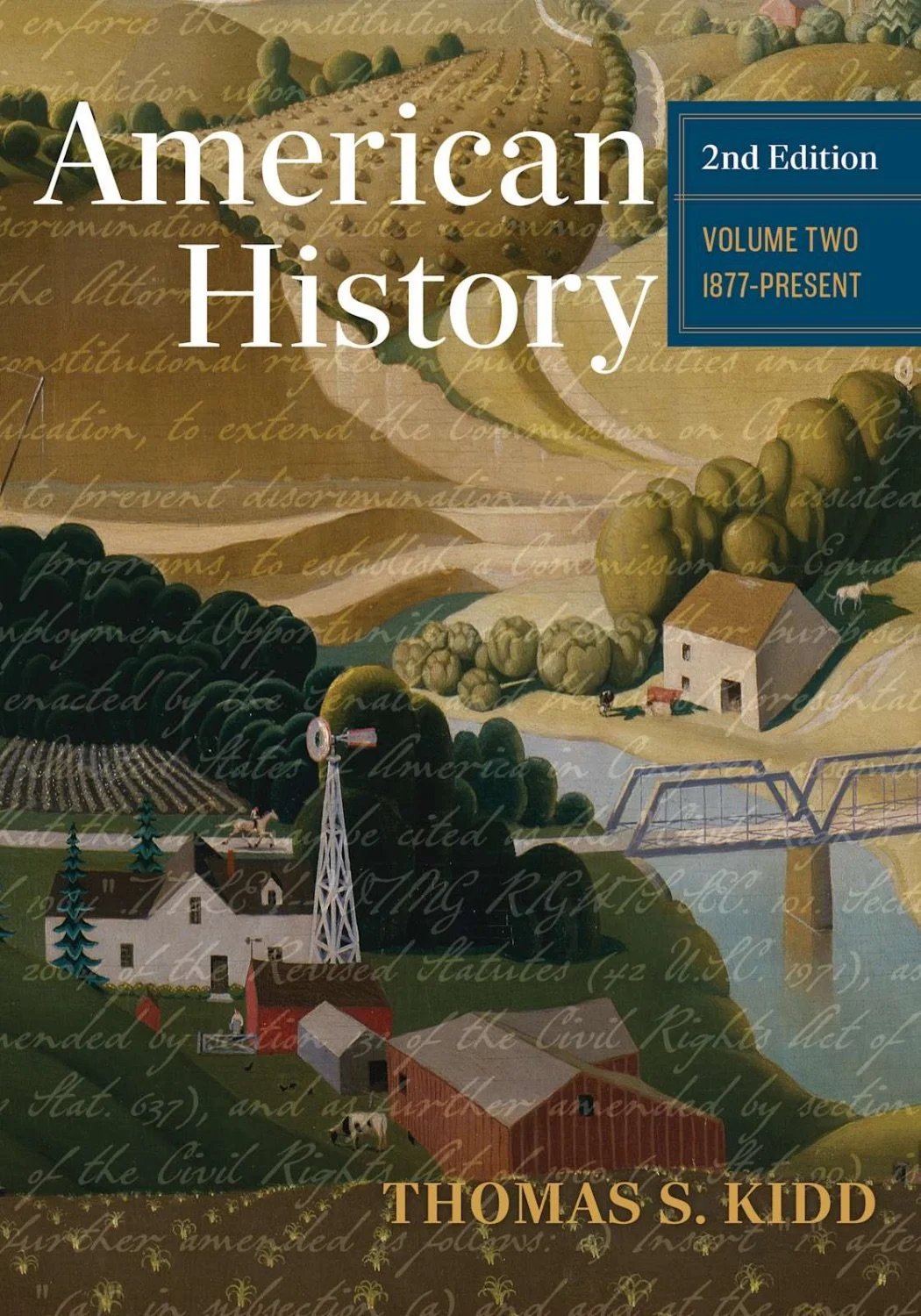
Lately I've been convicted of my need to better know the history of my own nation, so that explains my recent reviews of Wilfred McClay's terrific "Land of Hope," as well as "American History: 1492-1877," the first volume of Thomas Kidd's series, which I finished back in March 2023. After some delay, I finally got around to the second volume of the series, and it is every bit as good as the first. This second book covers the rest of American history, starting from 1877 (during the time of reconstruction after the Civil War), and moving forward to the election of Donald Trump to the White House in 2016.
What sets these books apart from other accounts of American history is Kidd's emphasis on three things: the presence and influence of religion in our nation's history (Kidd is a Christian himself, serving as a history teacher at Baylor University); the ongoing challenge of racial and ethnic conflict, including the continued struggles faced by minorities in our nation; and finally, the influence of sports and entertainment on popular culture, including the declining value placed on religion, marriage and family.
Regarding the influence of religion, Kidd discusses how decisions of the courts have increasingly moved our nation to a place where we now have the "full establishment of secularism as a negative form of religion" (p.247). It seems startling to us today, but in the 1960s, in most parts of the country, there was "broad-based support for religious teaching or Bible reading in schools." (p.246). And in the 1910s and 1920s, many states required the King James Bible as part of schools' curricula (p.41). But courts began to interpret the establishment clause of our Constitution as applying to any generic public expression of religious conviction, causing religion to take an increasing back-seat role in American culture. (Kidd even mentions the formation of the PCA in 1973 "over concerns about liberal theology and the ordination of women as pastors" -- p.263).
Regarding racial conflict, Kidd shares numerous anecdotes, such as the story of Fannie Lou Hamer, who fought for civil rights in Mississippi in the 1960s. Hamer was arrested and then beaten and tortured by police while in jail. An all-white jury exonerated the perpetrators, but Hamer stood strong on her Christian faith, asking one of her jailers: "(Do you) every wonder how you'll feel when the time comes (that) you'll have to meet God?" (p.241). In the last two decades of the 1800s, immediately after the Civil War, thousands of African Americans were lynched, with many being tortured as public spectacles (p.85). It is true that progressives have made an industry out of "white guilt," and have downplayed the virtues of the American experiment, but we can't ignore or forget that many such atrocities are a sad part of our history.
* Regarding popular culture, Kidd highlights the advent of college football, which even in the late 1800s people thought was too violent, with players suffering serious injuries and even death on the field. President Teddy Roosevelt responded that football was the "best school for instilling into the young man those attributes which business desires" (p.39). Kidd mentions the influence of rock music, which in the 1950s "idealized rebelliousness and an independent teenage culture" (p.217), and the "hippie culture," which "glamorized New Age religion and the use of drugs..." (p. 25). Television in the 1950s changed everything, with some observers suggesting it was making people more isolated and unreflective. Poet T.S. Eliot marveled that TV was a medium of entertainment which "permits millions of people to listen to the same joke at the same time, and yet remain lonesome." (p.210). What would Eliot say about the smart phone today?
Like the first volume, this book keeps the story moving at a brisk pace by not getting bogged down in details; it includes facts and figures but shares many interesting human interest stories as well; and it does a good job of not taking political sides on the controversial issues that have arisen over the years. (Even Kidd's brief description of Donald Trump at the end of the book does not reveal his own personal feelings about our 47th president).
If the future of our nation is in peril, as many observers warn, one reason is because the citizens of our nation don't know where we've come from or what we've been through. We don't know our history. We don't know who we are. So I would highly recommend both of these volumes to anyone with an interest in our past, but also with an interest in preserving our future.
Book Review: “American History, Volume 2, 2nd Edition: 1877 - Present” by Thomas S. Kidd

Next
Next