
February 2026
Podcasts
On the day before Valentine’s Day, 2024, a book by sociologist Brad Wilcox called Get Married: Why Americans Must Defy the Elites, Forge Strong Families, and Save Civilization hit the shelves. According to Wilcox, research doesn’t support the liberal notion that the way to happiness is to stay single, focus on your career, and make lots of money. Instead, one of the best predictors of happiness is a good marriage. You can listen to Wilcox elaborate on some of the findings in this interview with Lila Rose.
February 12, 2026, was the 217th anniversary of Charles Darwin’s birth. Darwin’s theory of evolution has held sway over the sciences for the last century. But some believe that might be changing. Check out this 2023 podcast from Uncommon Knowledge that begins with the question, “Who’s dead: God or Charles Darwin?” The episode features prominent intelligent design advocates Stephen Meyer, John Lennox, and Michael Behe who expose some of the growing holes in Darwin’s theory while highlighting some of the ways recent scientific discoveries point to the Creator.
Articles
Some of the New Life men recently finished considering the qualifications for officers in 1 Timothy 3 as part of the Thursday evening Men’s Bible Study. The reference in verse 11 to deacons’ wives (or literally “the women”) leads some interpreters to conclude that the New Testament permits women to serve as ordained deacons. For a summary of the biblical arguments commonly made both for and against female deacons, read the succinct Crossway article by Matt Smethurst. In the footnotes to his article, you can find additional references to other relevant online articles by Guy Waters (arguing against female deacons) and Thomas Schreiner (arguing for female deacons).
“Can Women Serve as Deacons? (Arguments For & Against)”
February 14 might be past, but love isn’t just for Valentine’s Day sweethearts. In a hard and rather unwelcomed truth, Jesus says it’s for our enemies, too. Read Pastor Brian’s recent article on loving our enemies on the Alcuin Study Center’s website.
6W Chronicles: Brief Profiles in Church History
As a way to introduce readers to some influential figures in the church’s past, the 6W Chronicles briefly address six questions: Who? When? Where? What did they do? Why should we know about them? What works can I reference by or about them?
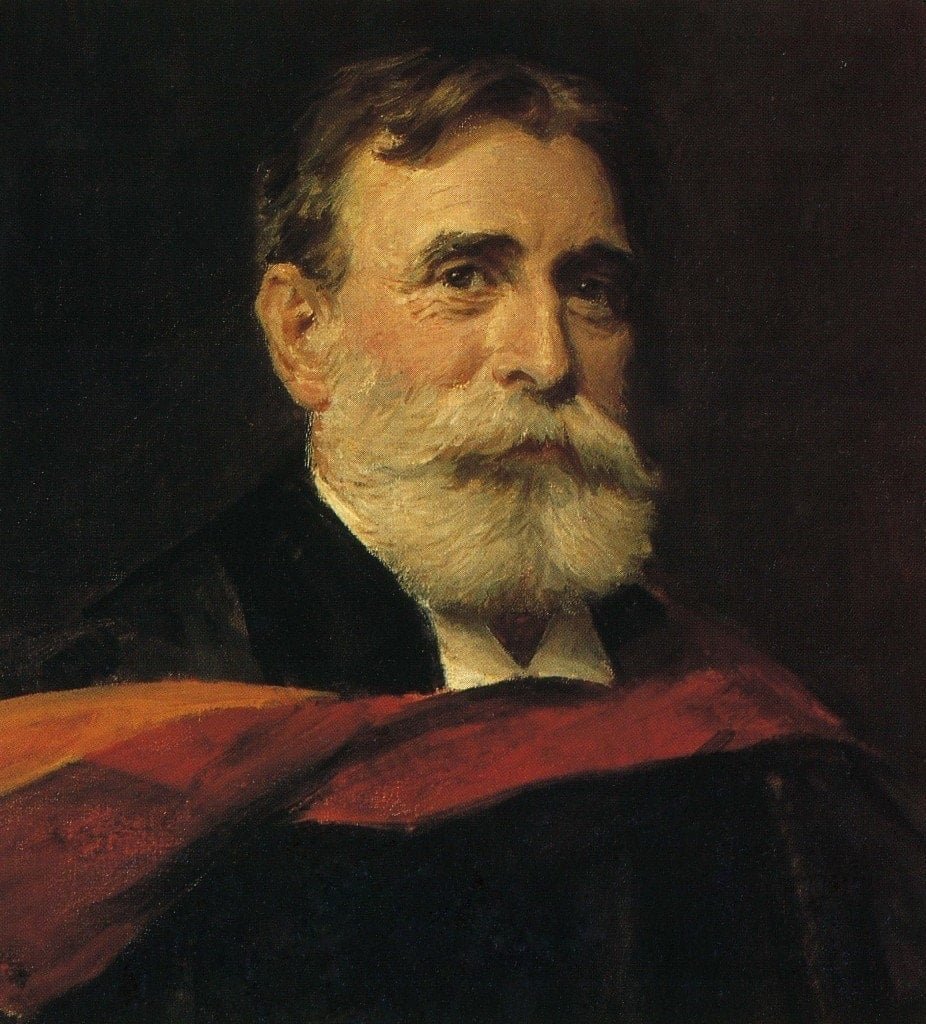
B.B. Warfield (Image from Banner of Truth)
Who? B. B. Warfield
When? 1851-1921
Where? Benjamin Breckinridge Warfield was born near Lexington, Kentucky on November 5, 1851, to William Warfield and Mary Cabell Breckinridge. He served on the faculty at Western Theological Seminary in Pittsburgh from 1879-1887 and at Princeton Seminary in New Jersey from 1887-1921.
What did he do? Warfield’s wife, Annie, suffered from some form of disability during much of his time at Princeton. As a result, the couple had no children, he rarely left her side except to teach his classes, and he rarely traveled. This allowed him to write extensively on a variety of subjects. He published twenty volumes of sermons, lectures, doctrinal treatises, and essays on various theological issues of his day. One of his finest and most highly regarded contributions is his work on the inspiration and authority of Scripture. He has been called the theologian of the doctrine of divine inspiration.
Why should we know about him? It has been written of Warfield that he was without peer during his time and unsurpassed in all the English-speaking world as a theologian. Warfield has been called “the man who propelled orthodoxy into the twentieth century.” A former acquaintance said of him after his death: “Dr. Warfield possessed the most perfect combination of faculties of mind and heart that I have ever known in any person.”
Works? If you’re looking for books by B. B. Warfield, you can start small with The Plan Of Salvation: The Order of God’s Decrees. If you’re feeling more ambitious, definitely check out The Inspiration and Authority of the Bible. It is superb. But almost everything written by Warfield is worth reading. If you want to read a book about Warfield and his work, Fred G. Zaspel’s recent Warfield on the Christian Life is a good place to start.
Theolingo: Building Your Theological Vocabulary
Theolingo aims to help you expand your learning of important theological terms. This month’s term is original sin.
Original sin in its technical theological sense refers not to the first sin of Adam (or Eve) but to the corruption of human nature that results from that first sin. We all inherit from Adam a sinful nature and “arrive on the scene” depraved. This sinful nature is present at the moment of our conception (see Psalm 51:5) and defiles the whole person: the mind, the conscience, the will, and the affections. According to historic Reformed theology, original sin renders us utterly indisposed, disabled, and made opposite to all that is spiritually good, and wholly and continually inclined to every kind of wickedness (see Westminster Larger Catechism Q. 25). It is from this inherited corrupt nature that all actual transgressions flow. The consequences of original sin were summarized memorably by R. C. Sproul when he said that we’re not sinners because we sin; we sin because we’re sinners.
Quotes
B. B. Warfield’s commitment to godliness in both heart and mind is captured well in this quote:
“Sometimes we hear it said that ten minutes on your knees will give you a truer, deeper, more operative knowledge of God than ten hours over your books. ‘What!’ is the appropriate response, ‘than ten hours over your books on your knees?’ Why should you turn from God when you turn to your books, or feel that you must turn from your books in order to turn to God? If learning and devotion are as antagonistic as that, then the intellectual life is in itself accursed, and there can be no question of a religious life for a student, even of theology.” – B. B. Warfield
Here's a small taste of Warfield’s perceptive teaching on the inspiration and authority of the Bible:
“What we are to accept as the truth of God is a comparatively easy question, if we can open our Bibles with the confident belief that what we read there is commended to us by a fully credible ‘Thus saith the Lord.’ But in proportion as we allow this or that element in it not to be safeguarded to us by this divine guarantee, do we begin to doubt the trustworthiness of more and more of the message delivered, and to seek other grounds of confidence than in the simple ‘It is written’ which sufficed for the needs of our Lord and His apostles.” – B. B. Warfield
Final Thought
There’s a parable about a battle going on between two wolves that live inside you. One wolf is evil, angry, jealous, greedy, arrogant, and violent. The other wolf is good, kind, compassionate, generous, humble, and truthful. The question is posed: which wolf will win? Answer: the one you feed. Pay attention to what you’re “eating” when you scroll, when you read, when you listen, when you ponder.
“For those who live according to the flesh set their minds on the things of the flesh, but those who live according to the Spirit set their minds on the things of the Spirit.” – Romans 8:5